
If you’re a student, aspiring data scientist, or someone exploring careers in artificial intelligence and data science, this guide is for you.
Most people understand that AI is “important,” but they struggle to clearly see how AI is actually used in data science in real-world scenarios.
In this blog, you’ll get a clear, practical breakdown of how artificial intelligence and data science work together—with real examples, tools, and use cases you can actually understand.
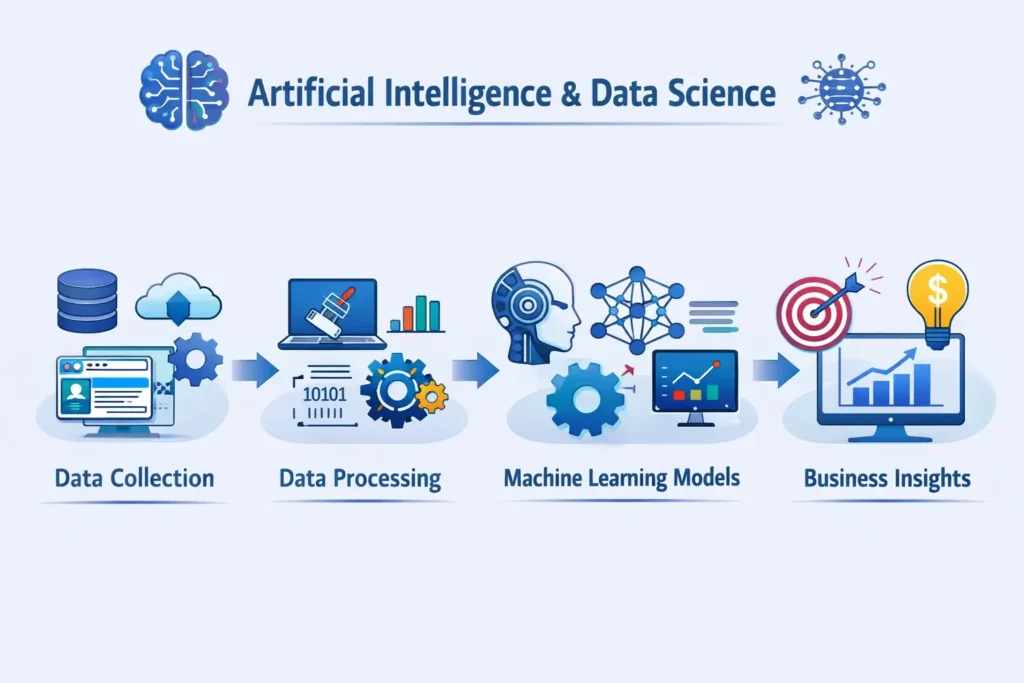
What is the Role of AI in Data Science?
At its core, artificial intelligence and data science are deeply connected.
- Data Science = Extracting insights from data
- Artificial Intelligence = Making machines learn and act on that data
👉 When combined, they automate decision-making and improve predictions.
Key Insight
- Over 80% of data science tasks today involve some form of AI or machine learning.
- Companies using AI-driven analytics report 20–30% faster decision-making.
7 Key Ways AI is Used in Data Science
1. Automating Data Cleaning
Data cleaning takes up 60–70% of a data scientist’s time.
AI helps by:
- Detecting missing values
- Fixing inconsistencies
- Removing duplicates
✅ Example: AI tools automatically standardize messy datasets.
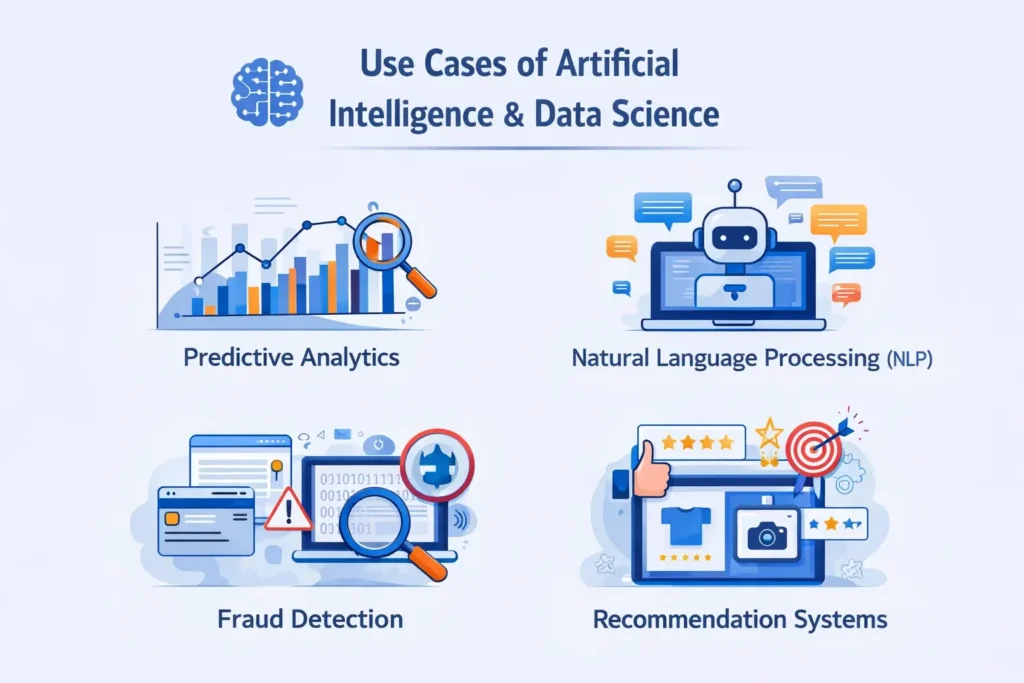
2. Predictive Analytics
This is where artificial intelligence and data science shine.
AI models:
- Predict sales
- Forecast demand
- Estimate risks
📊 Businesses using predictive analytics see up to 25% increase in revenue accuracy.
3. Natural Language Processing (NLP)
AI enables machines to understand human language.
Use cases:
- Chatbots
- Sentiment analysis
- Text classification
Example: Analyzing customer reviews automatically.
4. Image and Video Analysis
AI helps data scientists analyze visual data.
Applications:
- Facial recognition
- Medical imaging
- Object detection
📈 AI-based image analysis improves accuracy by up to 90% in healthcare diagnostics.
5. Recommendation Systems
Ever wondered how Netflix or Amazon suggest products?
That’s artificial intelligence and data science at work.
- Personalized recommendations
- User behavior analysis
💡 These systems drive 35%+ of revenue for major platforms.
6. Fraud Detection
AI detects unusual patterns in data.
- Banking fraud
- Insurance claims
- Cybersecurity threats
⚠️ AI reduces fraud losses by up to 40%.
7. Automated Machine Learning (AutoML)
AI now builds AI models.
- Selects algorithms
- Tunes parameters
- Speeds up development
⏱️ Reduces model-building time by 50–70%.
Tools Powering AI in Data Science
Here’s a quick comparison:
| Tool | Use Case | Popularity |
| Python | Core programming | ⭐⭐⭐⭐⭐ |
| TensorFlow | Deep learning | ⭐⭐⭐⭐ |
| Scikit-learn | Machine learning | ⭐⭐⭐⭐⭐ |
| Power BI | Visualization | ⭐⭐⭐⭐ |
| Apache Spark | Big data | ⭐⭐⭐⭐ |
👉 Learning these tools is essential if you want to build a career in artificial intelligence and data science.
Real-World Applications of AI in Data Science
Healthcare
- Disease prediction
- Drug discovery
Finance
- Risk analysis
- Fraud detection
E-commerce
- Product recommendations
- Customer segmentation
Marketing
- Targeted ads
- Customer insights
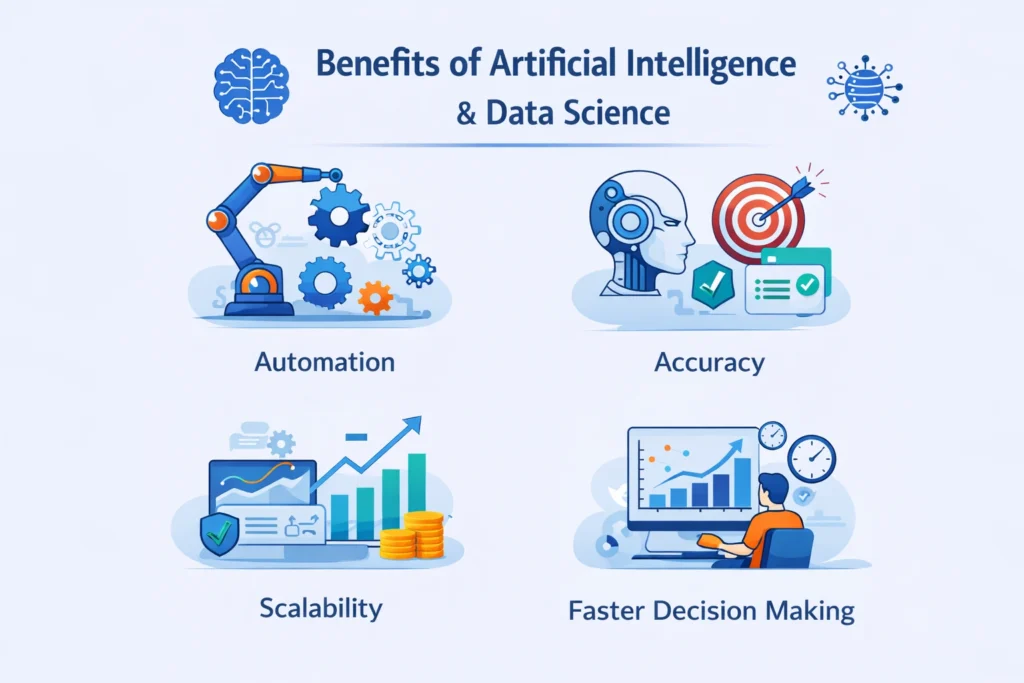
Benefits of Combining AI and Data Science
- Faster decision-making
- Higher accuracy
- Automation of repetitive tasks
- Scalability
📊 Companies using artificial intelligence and data science effectively are 5x more likely to make faster business decisions.
Challenges You Should Know
Let’s be honest—this field isn’t easy.
- Data privacy issues
- Model bias
- High computational cost
- Skill gap
👉 If you ignore these, your understanding of artificial intelligence and data science stays shallow.
How TheDataBrew Helps You Get Started
If you’re serious about building a career in artificial intelligence and data science, random YouTube tutorials won’t cut it.
The DataBrew helps you with:
- Structured learning paths
- Real-world projects
- Mentorship from experts
- Industry-relevant skills
👉 Instead of learning theory, you actually build things that matter.
Future of AI in Data Science
- AI-driven automation will replace repetitive tasks
- Demand for skilled professionals will grow by 30–35% by 2030
- Generative AI will reshape data workflows
👉 The future belongs to those who can combine artificial intelligence and data science effectively.
FAQs
Q1: Is AI necessary for data science?
Yes. Modern data science heavily depends on AI for predictions and automation.
Q2: Can I learn AI without coding?
Basic understanding is possible, but coding is essential for real-world work.
Q3: Which is better: AI or data science?
Neither. They work best together.
Q4: Is AI in data science a good career?
Yes. It’s one of the highest-paying and fastest-growing fields globally.
Final Thoughts
If you still think AI and data science are separate, you’re already behind.
The real power lies in combining artificial intelligence and data science to solve real-world problems.
Start Your Data Science Journey Today
Don’t just consume content—build real skills.
👉 Join TheDataBrew and start working on real-world AI projects, guided by experts.
Author Section
Nachiket Dixit
Data Scientist | Machine Learning Engineer | Analytics Mentor
Nachiket Dixit is a data science and artificial intelligence professional with hands-on experience in building real-world machine learning solutions and mentoring aspiring data professionals. He specializes in transforming complex data problems into actionable business insights.