
If you are a student, aspiring data scientist, or working professional exploring ai data science, you’ve probably heard terms like machine learning, deep learning, or generative AI—but it all feels confusing.
The problem? Most content explains AI in a complex way without breaking down the types of AI clearly.
This blog solves that by giving you a simple, structured breakdown of the 7 types of AI, with real-world examples and use cases so you actually understand how AI works in ai data science.
Why Understanding Types of AI Matters in AI Data Science
AI is not just one thing—it’s a collection of systems with different capabilities.
- The global AI market is expected to cross $1.8 trillion by 2030 (Statista)
- Over 75% of companies are already using AI in some form (McKinsey)
- Most AI jobs today require understanding multiple types of AI systems
👉 If you don’t understand the types, you’ll struggle to choose the right tools in ai data science projects.
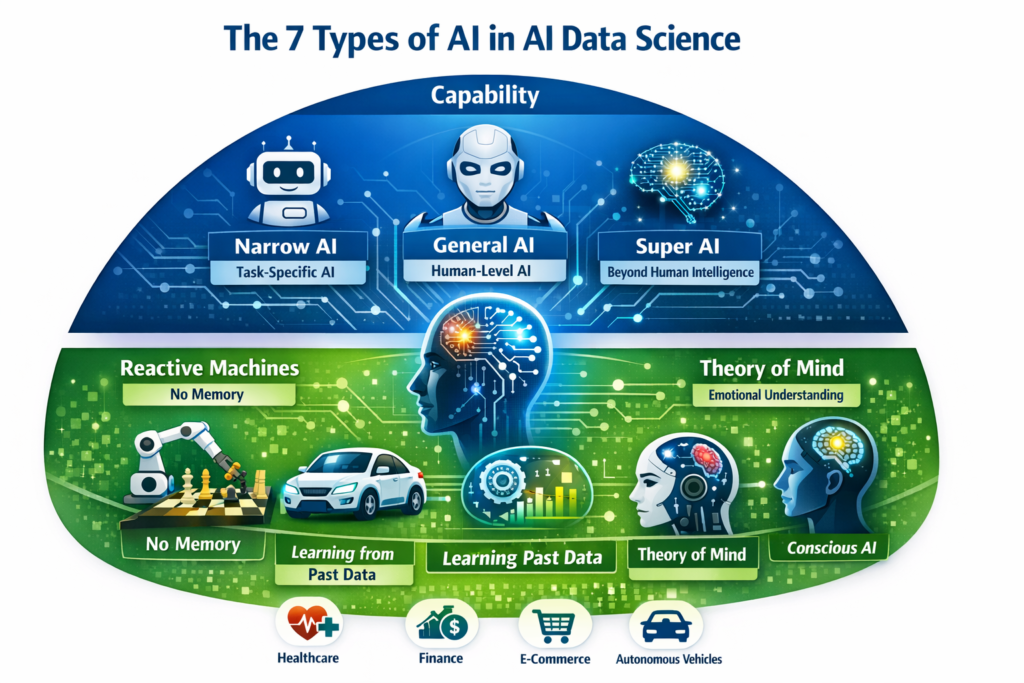
The 7 Types of AI (Quick Overview Table)
| Category | Type of AI | Description | Example |
| Capability-based | Narrow AI | Performs one task | Chatbots |
| Capability-based | General AI | Human-level intelligence | Still theoretical |
| Capability-based | Super AI | Beyond human intelligence | Future concept |
| Functionality-based | Reactive Machines | No memory | Chess AI |
| Functionality-based | Limited Memory | Uses past data | Self-driving cars |
| Functionality-based | Theory of Mind | Understands emotions | Under development |
| Functionality-based | Self-aware AI | Conscious AI | Hypothetical |
1. Narrow AI (Weak AI)

What It Means
Narrow AI is designed to perform a specific task extremely well.
Examples
- Google Search algorithms
- Netflix recommendation system
- ChatGPT-like tools
Key Insight
👉 Around 90% of AI systems used today fall under Narrow AI
In ai data science, this is the most practical type you’ll work with.
2. General AI (Strong AI)
What It Means
General AI would be capable of performing any intellectual task like a human.
Current Status
- Still under research
- No real-world system exists yet
Reality Check
If you’re thinking this is close—you’re wrong. Even advanced AI models today are still far from true General AI.
3. Super AI
What It Means
AI that surpasses human intelligence in all areas.
Examples
- Fully autonomous decision-making systems
- Advanced scientific discovery AI
Reality
👉 This is purely theoretical and raises ethical concerns in ai data science.
4. Reactive Machines
What It Means
These AI systems do not store memory and react only to current inputs.
Example
- IBM Deep Blue (Chess AI)
Use Case in AI Data Science
- Rule-based models
- Basic automation systems
5. Limited Memory AI
What It Means
These systems use past data to make better decisions.
Examples
- Self-driving cars
- Fraud detection systems
- Recommendation engines
Why It Matters
👉 Most real-world AI data science applications use Limited Memory AI
This is where machine learning and deep learning come in.
6. Theory of Mind AI
What It Means
AI that can understand human emotions, beliefs, and intentions.
Current Progress
- Emotion AI
- Human interaction models
Limitation
Still under development—no complete system exists.
7. Self-Aware AI
What It Means
AI that has consciousness and self-awareness.
Reality Check
- Purely hypothetical
- No real-world implementation
Capability vs Functionality (Comparison Section)
| Basis | Capability-Based AI | Functionality-Based AI |
| Focus | Intelligence level | Working mechanism |
| Types | Narrow, General, Super | Reactive, Limited Memory, Theory of Mind, Self-aware |
| Use in ai data science | Strategic understanding | Practical implementation |
Where These AI Types Are Used in Real Life
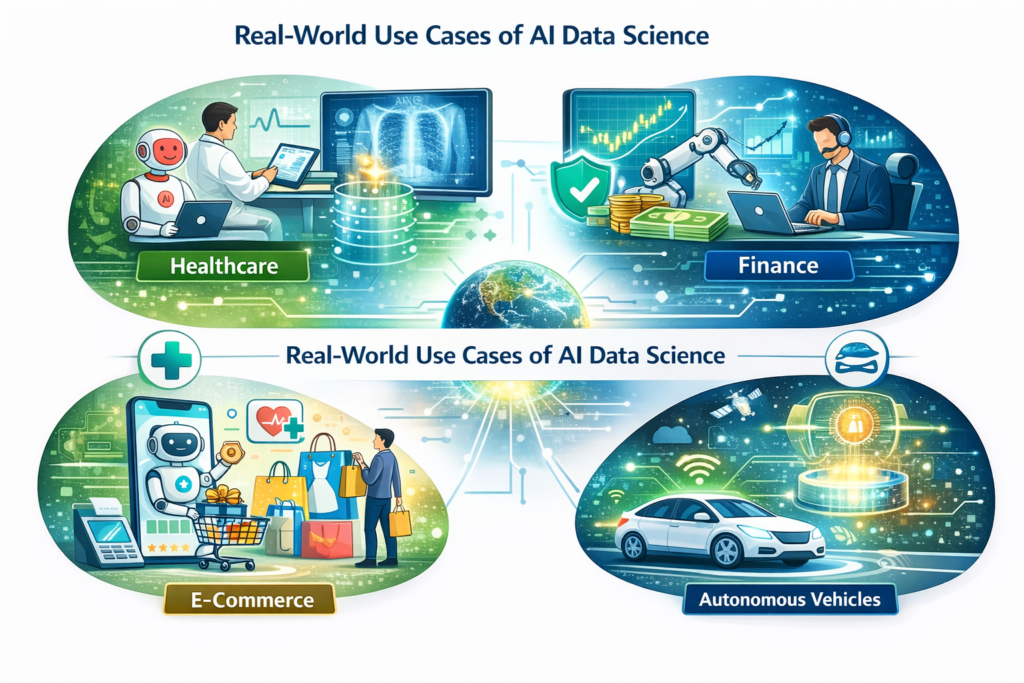
- Healthcare → Disease prediction (Limited Memory AI)
- Finance → Fraud detection (Narrow AI)
- E-commerce → Recommendations (Narrow AI)
- Automotive → Self-driving cars (Limited Memory AI)
👉 This is why understanding AI types is critical for building ai data science careers.
How TheDataBrew Helps You Learn AI Data Science
If you’re serious about building a career in ai data science, you need more than theory—you need real-world exposure.
At TheDataBrew, you get:
- Hands-on projects
- Industry-relevant curriculum
- Mentorship from working professionals
- Career-focused learning
👉 Instead of just learning concepts, you learn how to apply AI types in real scenarios.
FAQs
Q.1 What are the main types of AI in ai data science?
The 7 main types include Narrow AI, General AI, Super AI, Reactive Machines, Limited Memory AI, Theory of Mind AI, and Self-aware AI.
Q.2 Which type of AI is most used today?
Narrow AI and Limited Memory AI dominate real-world ai data science applications, accounting for over 90% of use cases.
Q.3 Is General AI already developed?
No, General AI is still theoretical and not yet achieved.
Q.4 Which AI type should I learn first?
Start with Narrow AI and Limited Memory AI as they are most relevant in ai data science careers.
Conclusion
Understanding the 7 types of AI is not just theory—it’s the foundation of building real-world systems in ai data science.
If you skip this clarity, you’ll struggle to choose the right models, tools, and career path.
🚀 Want to build a career in AI and Data Science?
Join TheDataBrew and learn:
- Real-world AI projects
- Industry tools
- Career-ready skills
👉 Start your journey today with TheDataBrew.
Author
Nachiket Dixit
Data Scientist | Machine Learning Engineer | Analytics Mentor
Nachiket Dixit is a data science and artificial intelligence professional with hands-on experience in building real-world machine learning solutions and mentoring aspiring data professionals. He specializes in transforming complex data problems into actionable business insights.