
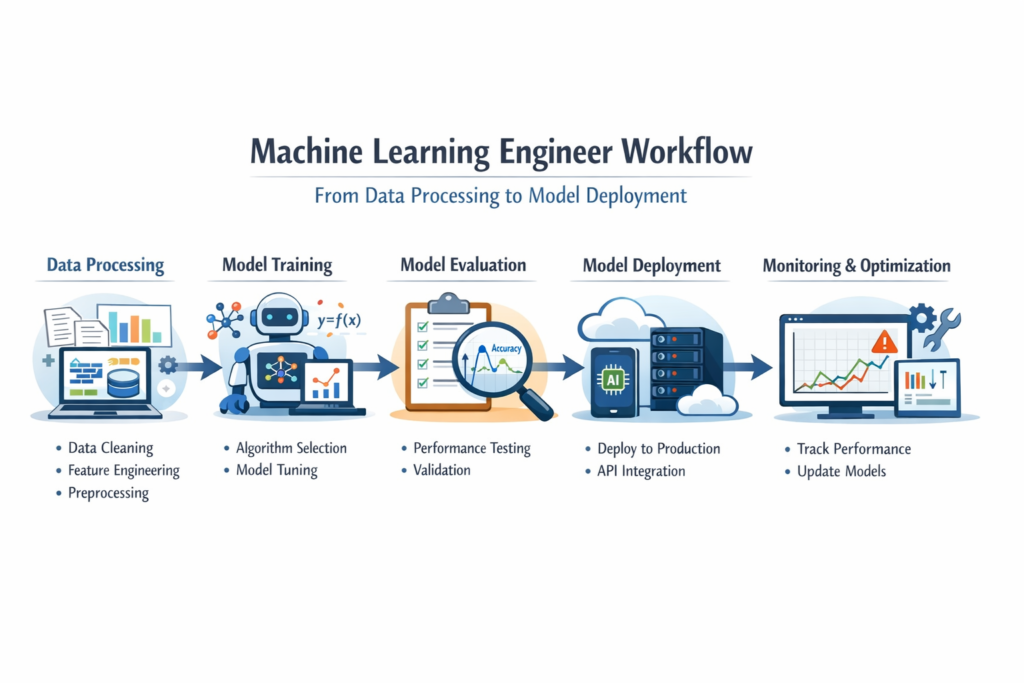
If you’re a student, aspiring data professional, or someone exploring careers in AI, you’ve probably heard the term ML engineer everywhere.
The problem? Most people don’t clearly understand what a ML engineer actually does day-to-day. Is it coding? Is it data science? Or something else entirely?
In this guide, we’ll break it down in simple terms—what a ML engineer really does, the skills required, and how you can become one.
What Is a Machine Learning Engineer?
A ML engineer is a professional who builds, trains, and deploys machine learning models into real-world systems.
Unlike data scientists (who focus more on analysis), a ML engineer focuses on:
- Production-ready models
- Scalable systems
- Automation pipelines
👉 In short:
They turn data science models into working products.
Key Responsibilities of a Machine Learning Engineer
Here’s what a typical ML engineer does:
1. Data Preparation & Processing
- Cleaning raw data
- Handling missing values
- Feature engineering
📊 Around 60–70% of time in ML projects is spent here.
2. Building Machine Learning Models
- Choosing algorithms (Regression, Trees, Neural Networks)
- Training models using frameworks like TensorFlow or PyTorch
- Hyperparameter tuning
3. Model Deployment
- Deploying models via APIs
- Using tools like Docker & Kubernetes
- Integrating models into apps
4. Monitoring & Optimization
- Tracking model performance
- Fixing model drift
- Improving accuracy over time
5. Collaboration with Teams
- Working with data scientists
- Coordinating with software engineers
- Aligning with business goals
Machine Learning Engineer vs Data Scientist
| Aspect | Machine Learning Engineer | Data Scientist |
| Focus | Deployment & systems | Analysis & insights |
| Coding | High (production-level) | Moderate |
| Tools | Docker, APIs, ML pipelines | Python, R, notebooks |
| Goal | Scalable ML systems | Business insights |
👉 Brutal truth:
If you don’t like coding + system design, ML engineering is not for you.
Skills Required to Become a Machine Learning Engineer
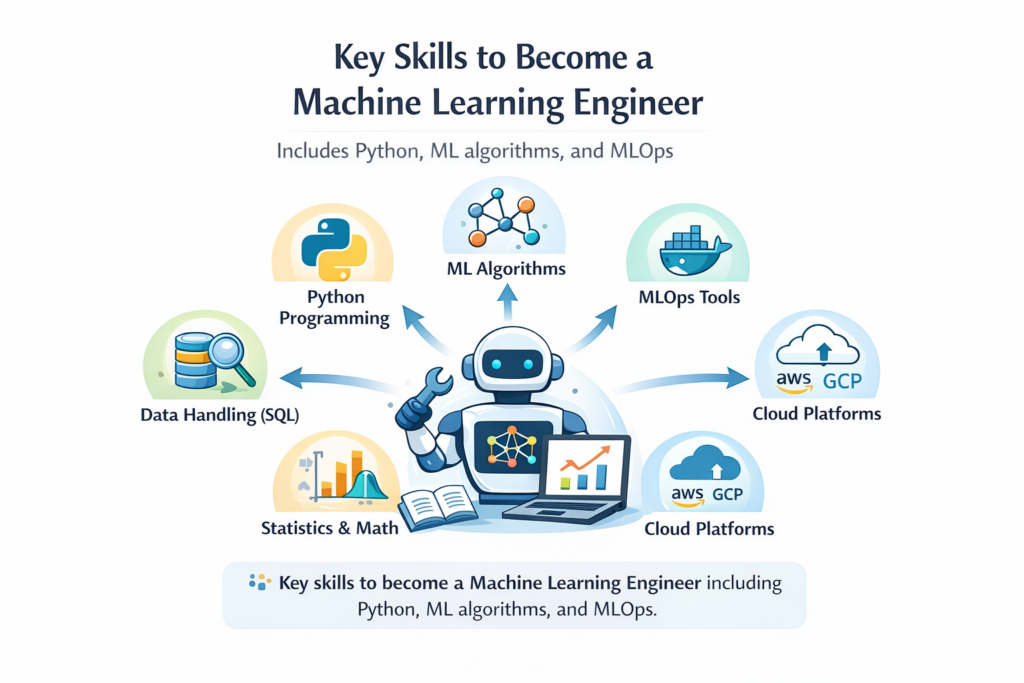
Technical Skills
- Python (mandatory)
- Machine Learning Algorithms
- Deep Learning basics
- SQL & Data Handling
- MLOps tools (Docker, Kubernetes)
Mathematical Skills
- Linear Algebra
- Probability & Statistics
Tools & Frameworks
- TensorFlow / PyTorch
- Scikit-learn
- AWS / GCP
Daily Workflow of a Machine Learning Engineer
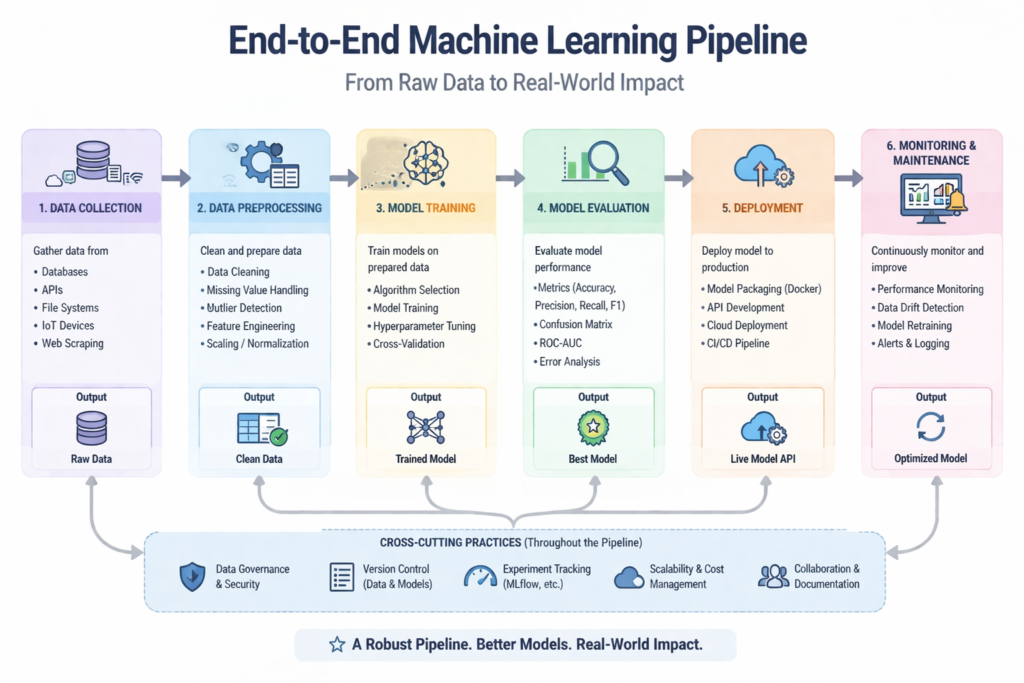
Here’s a realistic breakdown:
- Understand business problem
- Collect & preprocess data
- Train ML model
- Validate performance
- Deploy model
- Monitor results
👉 Most beginners think it’s just “training models.”
Reality: Deployment & maintenance is where 70% of the complexity lies.
Salary of a Machine Learning Engineer (2026)
| Level | Average Salary (India) |
| Entry-Level | ₹6–10 LPA |
| Mid-Level | ₹12–25 LPA |
| Senior-Level | ₹30+ LPA |
🌍 Globally, salaries can exceed $120,000/year.
How to Become a Machine Learning Engineer
Step-by-Step Roadmap
- Learn Python & Data Structures
- Study Machine Learning fundamentals
- Build real-world projects
- Learn MLOps tools
- Practice deployment
- Apply for internships/jobs
👉 If you skip projects, you will struggle to get hired. No exceptions.
Real-World Applications of Machine Learning Engineers
- Recommendation systems (Netflix, Amazon)
- Fraud detection
- Self-driving cars
- Chatbots & AI assistants
Why Learn Machine Learning with TheDataBrew
If you’re serious about becoming a ML engineer, random tutorials won’t cut it.
At TheDataBrew, you get:
- Structured learning paths
- Real-world projects
- Mentorship from industry experts
- Career-focused training
👉 Instead of wasting months figuring things out, follow a proven roadmap.
Common Mistakes to Avoid
- Learning theory without projects
- Ignoring deployment skills
- Not practicing coding daily
- Over-relying on courses
👉 Reality check:
Companies don’t hire based on certificates—they hire based on what you can build.
FAQs
Q1: Is machine learning engineer a good career?
Yes. It’s one of the highest-paying and fastest-growing roles in tech.
Q2: Do machine learning engineers need coding?
Absolutely. Strong coding skills are non-negotiable.
Q3: How long does it take to become a machine learning engineer?
Typically 6–12 months with focused learning and projects.
Q4: Is machine learning harder than data science?
Yes, because it involves both modeling + engineering + deployment.
Q5: Can a fresher become a machine learning engineer?
Yes, but only with strong projects and practical experience.
Conclusion
A ML engineer is not just someone who builds models—they build real-world AI systems that scale.
If you’re willing to:
- Code daily
- Build projects
- Learn continuously
Then this career can be extremely rewarding.
🚀 Ready to become a ML engineer?
Start your journey with TheDataBrew and learn through real-world projects, mentorship, and industry-ready skills.
👉 Don’t just learn—build and grow.
Author
Nachiket Dixit
Data Scientist | Machine Learning Engineer | Analytics Mentor
Nachiket Dixit is a data science and artificial intelligence professional with hands-on experience in building real-world machine learning solutions and mentoring aspiring data professionals. He specializes in transforming complex data problems into actionable business insights.