
If you’re a student, graduate, or career switcher wondering whether a data science degree is worth it, you’re asking the right question—but probably too late.
Most people jump into a data science degree without understanding what roles they’ll actually land, what skills are expected, and whether the market is already saturated.
This blog solves that problem by breaking down real career paths, expected salaries, and what it actually takes to succeed—so you don’t waste 3–4 years chasing vague “data jobs.”
Why a Data Science Degree Still Matters (But Isn’t Enough)
Let’s be honest:
A data science degree alone won’t get you hired anymore.
According to industry reports:
- Over 70% of data science job postings require practical experience
- Entry-level roles receive 200–500+ applications per job
- Candidates with projects are 3x more likely to get shortlisted
👉 Translation: Your degree gets you eligible, not selected.
Top Careers You Can Pursue with a Data Science Degree in 2026
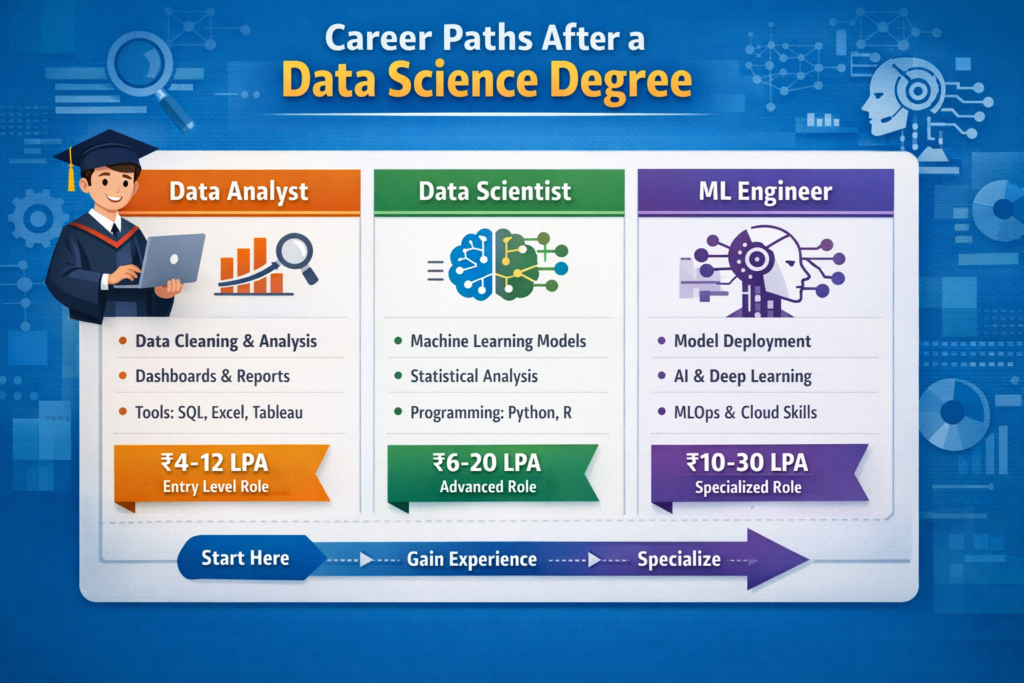
1. Data Scientist
What you’ll do:
- Build predictive models
- Analyze trends
- Work with business teams
Skills required:
- Python / R
- Machine Learning
- Statistics
- Data Visualization
Average Salary (India):
₹6–20 LPA (can go up to ₹35 LPA with experience)
Reality check:
Most “data scientist” roles at entry level are actually data analyst roles in disguise.
2. Data Analyst
What you’ll do:
- Clean and analyze data
- Create dashboards
- Generate reports
Tools:
- SQL
- Excel
- Power BI / Tableau
Average Salary:
₹4–12 LPA
Why this role matters:
This is the most realistic first job after a data science degree.
3. Machine Learning Engineer
What you’ll do:
- Deploy ML models into production
- Optimize algorithms
- Work with APIs and systems
Skills:
- Python
- Deep Learning
- MLOps
- Cloud platforms
Average Salary:
₹10–30 LPA
Brutal truth:
This role requires engineering-level skills, not just theory.
4. Data Engineer
What you’ll do:
- Build data pipelines
- Manage databases
- Work with big data tools
Tools:
- SQL
- Hadoop / Spark
- ETL pipelines
Average Salary:
₹8–25 LPA
Market insight:
Data engineers are often more in demand than data scientists.
5. Business Intelligence (BI) Analyst
What you’ll do:
- Create dashboards
- Track KPIs
- Help decision-making
Tools:
- Power BI
- Tableau
- SQL
Average Salary:
₹5–15 LPA
6. AI Engineer
What you’ll do:
- Build AI systems (chatbots, recommendation engines)
- Work on NLP and computer vision
Skills:
- Deep Learning
- TensorFlow / PyTorch
- NLP
Average Salary:
₹12–35 LPA
Career Comparison Table
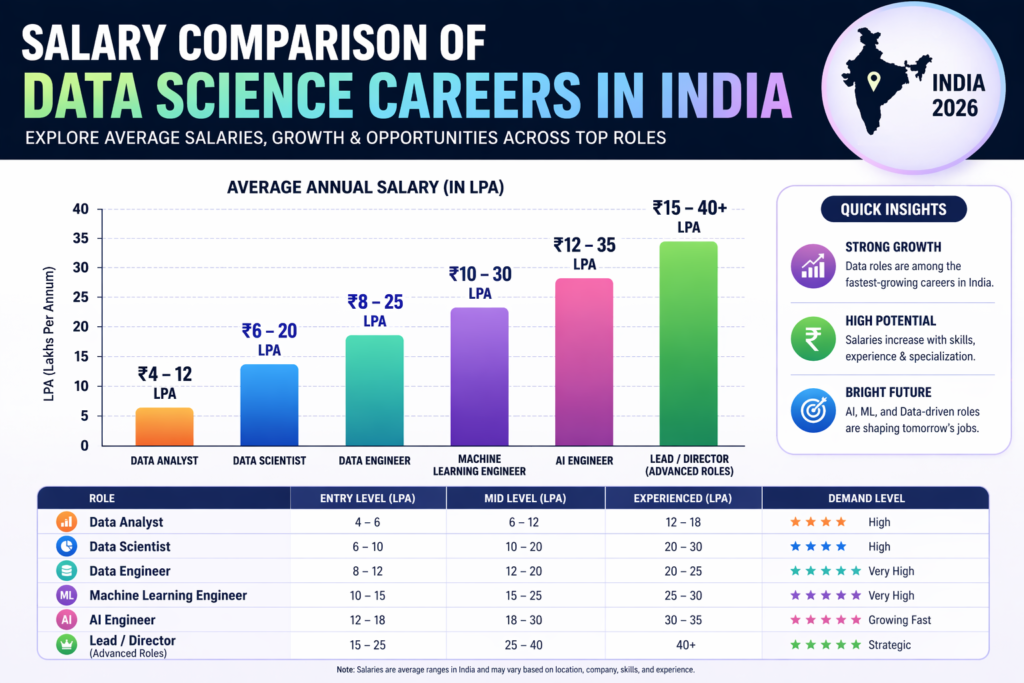
| Role | Difficulty | Salary Range | Entry-Level Friendly | Demand Level |
| Data Analyst | Low | ₹4–12 LPA | ✅ High | 🔥 High |
| Data Scientist | Medium | ₹6–20 LPA | ⚠️ Medium | 🔥 High |
| ML Engineer | High | ₹10–30 LPA | ❌ Low | 🔥 Very High |
| Data Engineer | High | ₹8–25 LPA | ⚠️ Medium | 🔥 Very High |
| BI Analyst | Low | ₹5–15 LPA | ✅ High | 🔥 High |
| AI Engineer | Very High | ₹12–35 LPA | ❌ Low | 🚀 Growing |
Skills You Actually Need Beyond a Data Science Degree
Here’s where most people fail.
A data science degree in 2026 teaches concepts.
Jobs require execution.
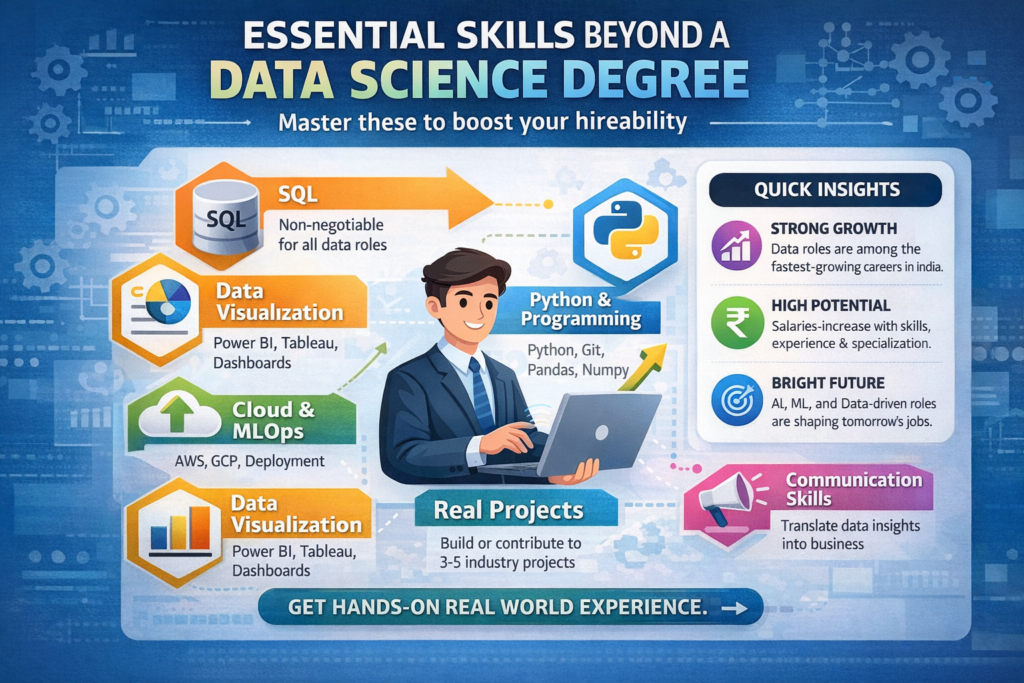
Must-have skills:
- SQL (non-negotiable)
- Python (pandas, numpy)
- Data visualization
- Real-world projects
- Communication skills
Bonus skills:
- Cloud (AWS, GCP)
- MLOps
- Domain knowledge (finance, healthcare, etc.)
Where TheDataBrew Fits In
Here’s the uncomfortable truth:
Most universities won’t teach you:
- Real datasets
- Industry workflows
- Deployment
That’s where TheDataBrew bridges the gap.
With hands-on projects, mentorship, and real-world case studies, you move from:
👉 “I know theory”
to
👉 “I can solve business problems”
And that’s what gets you hired.
Career Path Roadmap (Simple Breakdown)
Stage 1:
- Learn basics (Python, SQL)
- Complete your data science degree
Stage 2:
- Build 3–5 strong projects
- Focus on real-world problems
Stage 3:
- Apply for analyst roles first
- Transition to advanced roles later
Stage 4:
- Specialize (ML, AI, Data Engineering)
FAQs
Q1: Is a data science degree enough to get a job?
No. Without projects and practical skills, your chances drop significantly.
Q2: Which is the best career after a data science degree?
Data analyst is the most accessible starting point. ML engineer and AI roles require advanced skills.
Q3: What is the highest paying job in data science?
AI engineers and ML engineers typically earn the highest salaries.
Q4: Can I get a job without coding?
Not realistically. At minimum, you need SQL and basic Python.
Q5: How long does it take to become job-ready?
6–12 months with focused learning and projects.
Final Thoughts
A data science degree in 2026 is not a golden ticket.
It’s a starting point.
If you:
- Avoid projects
- Skip fundamentals
- Depend only on college
You’ll struggle.
But if you:
- Build real-world skills
- Learn consistently
- Use platforms like TheDataBrew
You can build a high-paying, future-proof career.
Start Your Data Career with TheDataBrew
Don’t just earn a degree—build a career.
👉 Learn real-world data skills
👉 Work on industry projects
👉 Get mentorship from experts
Start your journey with TheDataBrew today.
Author Section
Nachiket Dixit
Data Scientist | Machine Learning Engineer | Analytics Mentor
Nachiket Dixit is a data science and artificial intelligence professional with hands-on experience in building real-world machine learning solutions and mentoring aspiring data professionals. He specializes in transforming complex data problems into actionable business insights.